For decades, the Union Public Service Commission (UPSC) has been sold to Indian middle-class families as the ultimate “Golden Ticket.” It’s framed as the pinnacle of success, the only way to “serve the nation.” But if you look closer at the streets of Old Rajinder Nagar or the thousands of study rooms across the country, a grimmer reality emerges.
We aren’t just selecting bureaucrats; we are systematically wasting the most productive years of our youth. The current system is a lottery disguised as a meritocracy, and it is failing both the aspirants and the country.
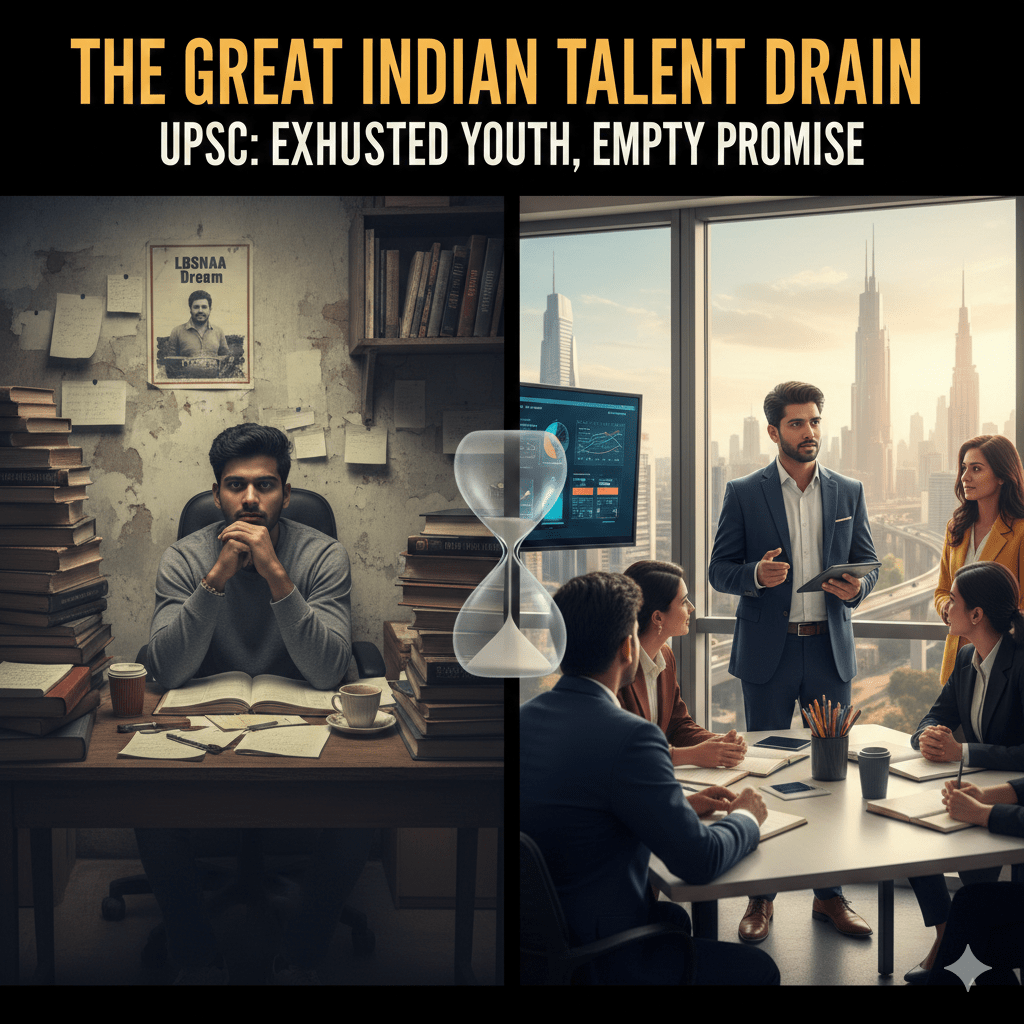
The current age criteria (starting at 21) encourages a culture of “isolation-based excellence.” We are taking 21-year-olds—many of whom have never held a job, never managed a conflict in a workspace, and never had to survive a month on a self-earned salary—and asking them to memorize the history of land reforms while sitting in a 6×6 cubicle.
By the time they enter the service, they have spent 4 to 6 years in an artificial bubble. They aren’t “youthful”; they are exhausted. They have mastered the art of writing what an examiner wants to hear, but they have zero “skin in the game.”
Imagine a civil service where the minimum entry age is 26 or 27, and a mandatory 3 years of work experience is required.
A person who has worked in a corporate firm knows how to meet deadlines and manage stakeholders.
A person who has run a small shop or a startup knows the pain of “Red Tape” firsthand.
A person who has worked in a hospital or a school knows that a policy on paper looks very different when it hits the ground.
We don’t need “Book-Smart” toppers who can recite the Constitution; we need “Life-Smart” leaders who have actually lived in the society they are about to govern.
The UPSC ecosystem has birthed a multi-billion dollar coaching industry that thrives on repeat failures. These institutes don’t make money when you pass; they make money when you fail and come back for another “Foundation Course.”
They sell a romanticized version of the “Lal Batti” (the red beacon) and “Power,” ignoring the fact that the odds of selection are less than 0.1%. This isn’t an exam; it’s a high-stakes gamble where the “House” (the coaching centers) always wins.
When a 28-year-old fails after five attempts, they aren’t just unemployed—they are often “unemployable.” They have no corporate skills, no technical expertise, and a massive gap in their CV that no HR manager knows how to fill. We are effectively creating a “lost generation” of over-educated but under-skilled adults.
The current UPSC philosophy is rooted in a 19th-century British colonial mindset: find a “bright generalist” and they can govern anything. But India in 2026 isn’t a collection of villages waiting for a collector to arrive on a horse; it’s a nuclear-armed, digitally-driven economy.
We are selecting people based on their ability to write an essay on “Philosophy in Science,” and then asking them to manage:
Urban Infrastructure: Complex drainage, traffic, and housing.
Cybersecurity: Protecting data in a hyper-connected world.
Public Health: Managing pandemics and rural nutrition.
By prioritizing academic breadth over domain expertise, we end up with bureaucrats who spend the first five years of their posting just learning the basics of the department they are supposed to lead. This “revolving door” policy, where an officer moves from Animal Husbandry to Information Technology in two years, ensures that visionary, long-term leadership is impossible. > The Fix: We need a system that recruits for specific “Silos.” If you have a background in Finance or have run a business, you should be channeled into Economic Administration. If you’ve worked in a tech startup, you belong in Digital Governance. Real-world experience isn’t a “bonus”—it should be the baseline.
We need to talk about what 16 hours of isolation for five years does to a human brain. The current system rewards the “Academic Monk”—the person who can cut themselves off from society, friends, and family to memorize data.
But public service is the most social job on Earth. When you spend your entire “youth” (21 to 28) in a room avoiding people to pass an exam, you don’t develop:
Empathy: The ability to feel the pulse of a grieving citizen or a struggling farmer.
Collaboration: The skill to work with a team rather than just “giving orders.”
Resilience: Real-world resilience comes from facing professional failure, not just “not seeing your name on a PDF.”
We are selecting for Endurance, but we need Emotional Intelligence (EQ). The current system creates “Toppers” who are often socially disconnected and mentally exhausted by the time they get their first posting. They aren’t entering the service to “change the world”; they are entering it because they finally finished a marathon and want to rest in the comfort of “job security.”
India cannot afford to have its smartest 1% sitting in libraries for a decade while the private sector and the social sector starve for talent.
Raising the age bar and demanding prior work experience isn’t just a policy change—it’s a way to save our youth. It gives them a “Plan B” by default. It ensures they have “Skin in the Game.” And most importantly, it ensures that the people running our country have actually lived in it first.
It’s time to stop treating the UPSC like a holy pilgrimage and start treating it like a professional recruitment process for the 21st century.
Copyright © 2025 thewisefox.in All Rights Reserved.